

New COACHE Survey Reporting Platform Supports Data Insights on Retentions and Exits
New COACHE survey reporting platform supports data insights on retentions and exits
Data and insight to help institutions with their faculty retention efforts are now easier to access, understand, and act on with the redesigned platform for COACHE’s Faculty Retention & Exit Survey. The new dynamic platform, developed with partner input, offers dynamic data and actionable insights, and is now available for both new and existing partners.
As the only comparative study of faculty retention and departures, the survey shows participating institutions the implications of certain policies and offers insight into the causes, costs, and conduct surrounding faculty exits.
The survey seeks feedback from three groups: faculty who ultimately left an organization; faculty who received an offer to work elsewhere in the past year, but were ultimately retained; and, optionally, faculty who were preemptively retained by an institution. It explores the primary reasons faculty leave — or ultimately stayed, how faculty were treated during the process, and the impact on the institution.
The new reporting platform offers dynamic features and data visualizations that enhance usability and facilitate data analysis, including segmenting and cross-tabulating data in real time. With the new platform, partners can more easily navigate through the report to better take action:
- Interpret key insights on faculty retention and departure with modules based on nine themes, ranging from report navigation to the analytic sample, to the negotiation process and preemptive retentions.
- Strategize communication of results to campus stakeholders with a customizable executive slide deck template.
- Access ongoing support through COACHE’s Roadmap of Engagement, which includes tutorial videos facilitating data interpretation, a webinar, a customizable presentation to share survey results, and more.
Additional resources in the report include comparative data from the COACHE cohort (consisting of other institutions who participated in the survey at the same time) and a self-selected group of peers; examples of how the survey data has benefited other campuses, systems, or consortiums of universities; strategies for responsibly handling and sharing survey data; and a full list of institutions included in the cohort.
“The COACHE Retention and Exit Survey has always provided a huge number of useful insights and data for participants, and now the information is more readily available to those institutional stakeholders who might not be used to assessing complex data sets,” says Todd Benson, executive director and principal investigator at COACHE. Since the survey first began in 2017, more than 50 institutions have taken part. “This new reporting platform has been over two years in the making, and we are excited to launch it to our partners. The feedback has been incredibly positive.”
In previous years, at a sector level, salary, quality of colleagues, and the reputation of the department or institution were given as top reasons by faculty to either leave or stay in their position of higher education. Institutions participating in the survey have the opportunity to see detailed data sets reflecting drivers in their own organizations.
Registration for the partners in the 2025 Faculty Retention & Exit Survey is now open. If you are interested in learning more about the COACHE Faculty Retention & Exit Survey, or if you are a previous partner who would like to walk through your results in the new platform, please contact Deborah Ruiz at deborah_ruiz@gse.harvard.edu.
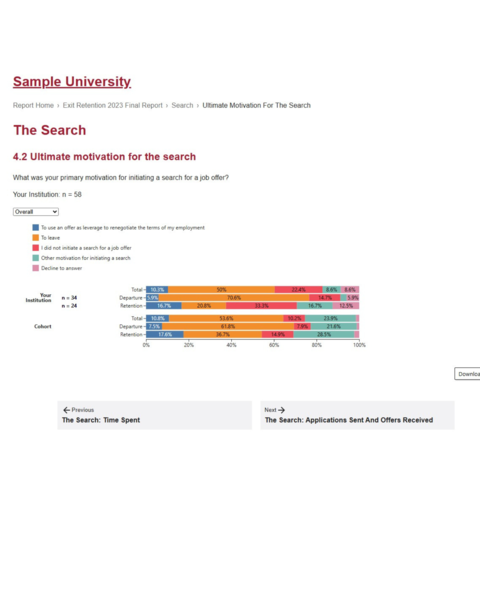
Exit Retention sample chart on faculty motivation for job search.
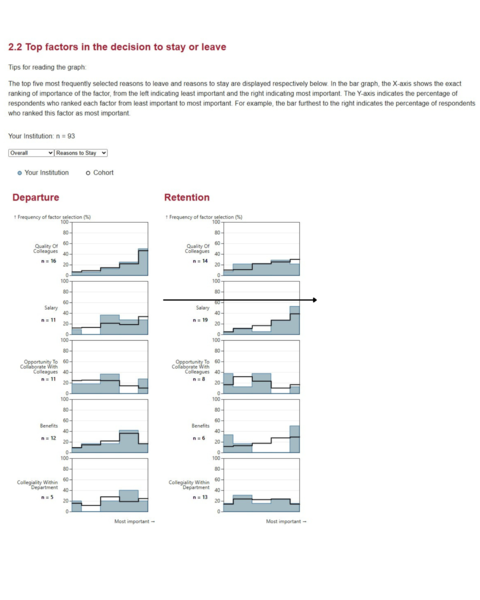
Exit Retention sample chart of top factors in faculty's decision to stay or leave.
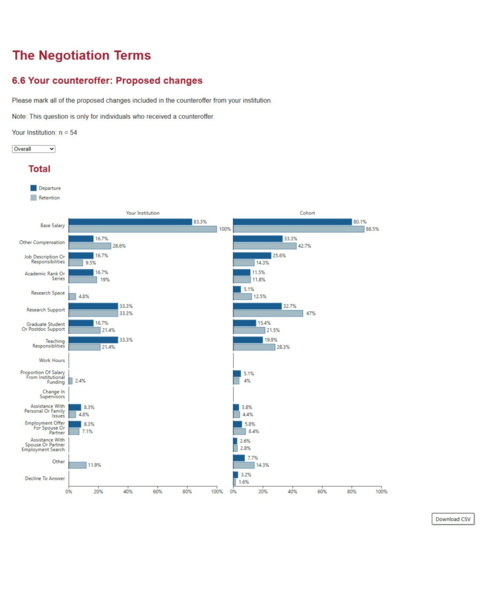
Exit Retention sample chart of an institution's faculty job negotiations, specifically counteroffers, as compared to the cohort.